Sustained wagering on a single football club across an entire domestic campaign is often viewed as a way to leverage deep tactical knowledge and reduce research overhead. By tracking one squad, a bettor aims to anticipate lineup shifts, injury recoveries, and tactical adjustments faster than general market consensus. However, blind commitment to a single side over a 28-match truncated season like the 2019/20 French Ligue 1 tests the boundary between analytical specialization and structural bookmaker pricing friction. Evaluating whether this monolithic approach yields genuine long-term value requires examining market pricing mechanisms, Asian Handicap coverage rates, and the mathematical reality of flat-stake returns.
The Core Mechanics of the Single-Club Betting Hypothesis
Focusing capital on a single team attempts to eliminate broad market noise in favor of granular team-level insight. In theory, closely monitoring tactical structures, managerial tendencies, and underlying performance metrics like expected goal differential (xG) allows a bettor to identify soft price points. When applied to clubs outside the media spotlight, this hyper-focused observation can occasionally uncover value before oddsmakers correct baseline team ratings.
Despite this theoretical advantage, fixed-team strategies face systemic friction from the bookmaker’s overround. Backing one club each matchday forces a bet into every pricing environment, regardless of whether value exists on that specific line. Instead of selecting the most mispriced fixtures across the entire league slate, the bettor accepts unfavorable numbers during stretches where the market overestimates the chosen team’s true baseline strength.
Empirical Performance Profiles Across Key 2019/20 Contenders
The truncated 2019/20 Ligue 1 campaign provides distinct case studies across title contenders, mid-table overachievers, and underperforming legacy clubs. Tracking flat 1-unit stakes on outright moneyline markets reveals stark divergences in theoretical profitability across different squad profiles.
The comparative dataset below illustrates the financial outcomes of backing selected clubs across all 28 completed matchdays during the 2019/20 season using closing market prices.
| Club Profile | Team | Record (W-D-L) | Total Staked | Flat-Stake Profit/Loss | Return on Investment (ROI) |
| Elite Heavyweight | Paris Saint-Germain | 22-2-3 (27 GP) | 27.0 Units | -1.14 Units | -4.22% |
| High-Efficiency Contender | Stade Rennais | 15-5-8 | 28.0 Units | +7.40 Units | +26.43% |
| Tactical Overachiever | Stade de Reims | 10-11-7 | 28.0 Units | +3.25 Units | +11.61% |
| Underperforming Giant | Olympique Lyonnais | 11-7-10 | 28.0 Units | -7.65 Units | -27.32% |
| Relegation Struggler | Toulouse FC | 3-4-21 | 28.0 Units | -17.80 Units | -63.57% |
The data confirms that raw win frequency does not correlate directly with investment yield. Paris Saint-Germain won over 81% of their fixtures, yet heavy market tax and crushed pricing produced a net negative yield over the season. Conversely, Rennes delivered a 26.43% return because oddsmakers systematically underpriced their defensive stability and counter-attacking efficiency against mid-tier opposition.
Comparing Outright Win Yields to Asian Handicap Coverage
Straight moneyline returns tell only part of the story, as high-profile clubs frequently face prohibitive match odds that force bettors into spread markets. For elite teams, covering large multi-goal lines demands consistent offensive dominance that often evaporates once a comfortable lead is established. A team may win matches consistently while failing to clear the spread, rendering moneyline and handicap performance fundamentally distinct.
The Paris Saint-Germain Dilemma: The Heavy Price of Elite Dominance
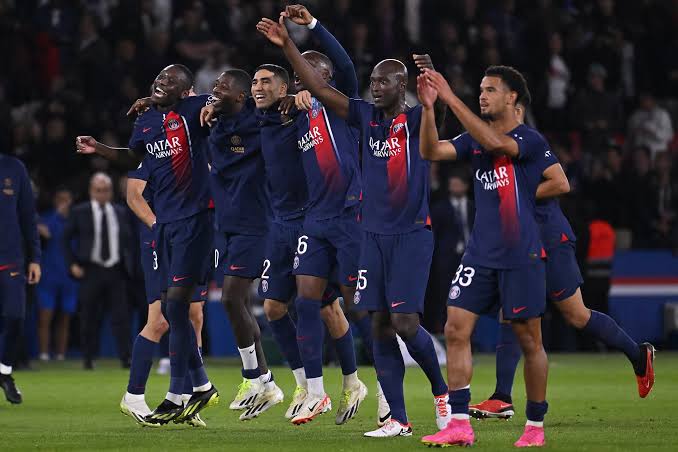
Wagering exclusively on Paris Saint-Germain throughout 2019/20 highlights the structural penalty of backing heavy favorites. Despite winning 22 of their 27 completed fixtures, average outright prices hovering between 1.10 and 1.25 meant that a single unexpected slip—such as their 2-1 defeat to Dijon or a 2-0 home loss to Reims—required multiple subsequent victories just to recover lost capital.
Asian Handicap lines for PSG routinely opened between -1.75 and -2.75 goals, requiring multi-goal victories to generate a payout. While Thomas Tuchel’s side produced several emphatic scorelines, tactical game management during congested fixture periods often led to lowered intensity after securing a two-goal lead. Consequently, PSG’s handicap coverage rate hovered near 50%, eroding profitability once the market spread absorbed the club’s statistical edge.
Value-Generating Anomalies: Mid-Table Outliers and Defensive Blocks
The most profitable single-team profiles in 2019/20 belonged to clubs whose defensive architecture went unrewarded by public betting volume. Stade de Reims conceded only 21 goals in 28 matches, recording the best defensive record in the league alongside PSG. Because Reims lacked high-profile attacking names, market odds consistently framed them as modest underdogs against mid-tier opponents.
Bettors who identified Reims’ low-variance defensive system could extract sustained value by targeting draw outcomes, double-chance lines, and under-total combinations. Their tactical discipline produced 11 draws across 28 fixtures, providing lucrative underdog payouts that easily outpaced the losses from their seven defeats.
Structural Vulnerabilities: Why Single-Team Loyalty Fails Long-Term
Adhering strictly to one club creates acute vulnerability to non-linear performance drops caused by internal and external shocks. Squad performance rarely follows a linear trajectory, and rigid betting systems fail to adapt when key foundational variables collapse mid-season.
The following sequence illustrates how single-team reliance systematically degrades portfolio capital when tactical or physical setbacks emerge:
- Key Personnel Depletion: An injury to an irreplaceable central playmaker or anchor defender shifts the underlying expected goal generation without immediately altering public bookmaker lines.
- Tactical Counter-Strategies: Rival managers analyze game film, identify predictable buildup patterns, and deploy low-block counters that nullify the target club’s primary offensive output.
- Psychological Fatigue and Congestion: Mid-season European fixtures force squad rotation, leading to diminished cohesion in domestic league outings.
- Sunk-Cost Staking Behavior: The bettor continues backing the club at depressed prices based on early-season perceptions rather than current statistical reality.
This structural decay demonstrates how an initial informational edge dissolves as season dynamics evolve, turning a specialized focus into an unhedged liability.
Analyzing seasonal data and monitoring fluctuations in team ratings demands comprehensive market coverage. Whenever market participants evaluate line movement through a dedicated sports betting service like ufabet168, comparing opening handicap shifts across European leagues reveals how public sentiment distorts individual team values over extended stretches of the competitive calendar.
Tactical Context and Matchup Dependency in Ligue 1
A single-team betting approach assumes that a club’s quality remains constant regardless of tactical style, ignoring the decisive role of stylistic matchups. A possession-oriented side might dismantle open, attacking opponents with ease while struggling repeatedly against compact five-man defensive structures that deny central passing lanes.
Olympique Lyonnais illustrated this mismatch throughout 2019/20, regularly dropping points against low-block teams like Amiens, Dijon, and Brest despite boasting superior individual talent. Bettors backing Lyon blindly absorbed consistent losses because the club’s tactical framework lacked the creative penetration required to break down disciplined mid-table defenses, illustrating why matchup analysis must supersede team loyalty.
Evaluating whether a team offers mathematical value across a full season requires viewing their odds within the broader entertainment and gaming landscape. When wagering across digital channels that offer comprehensive sportsbook listings alongside typical casino online website features, recognizing that every market carries a built-in operational margin underscores the necessity of selective value-hunting rather than repetitive single-club backing.
Conditional Performance Under Varied Game States
A team’s profitability often hinges on specific situational conditions rather than overall quality. Some squads excel exclusively as home favorites where they control tempo, while others generate high return on investment exclusively as away underdogs suited for rapid counter-attacks. Backing a team indiscriminately across all venues and game states erodes the specific contextual advantages that make them profitable in targeted scenarios.
Summary
Backing a single club across the entire 2019/20 Ligue 1 campaign was profitable only when applied to systematically undervalued defensive units like Stade Rennais (+26.43% ROI) and Stade de Reims (+11.61% ROI). Elite front-runners like Paris Saint-Germain generated net losses due to compressed market pricing and inflated handicap lines, while underperforming sides like Lyon and Toulouse severely damaged flat-stake bankrolls. Blind single-team loyalty forces capital into negative-value fixtures, ignores stylistic matchup dependencies, and leaves bettors vulnerable to mid-season tactical decay. Selective market entry based on contextual value remains fundamentally superior to season-long team