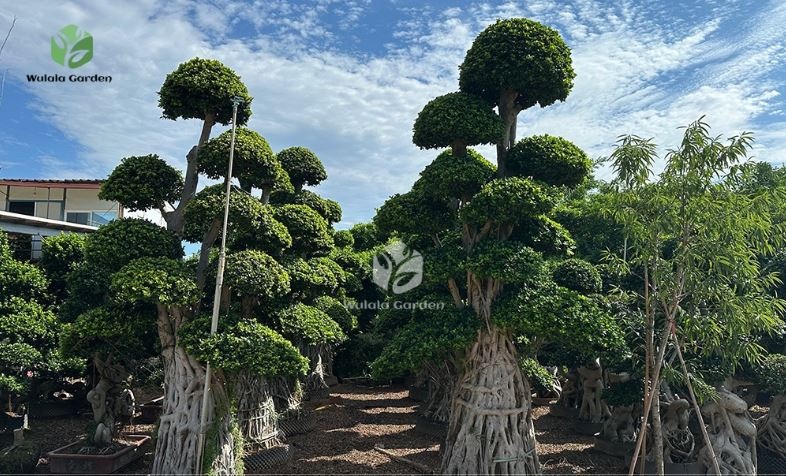
Aerial roots can be one of the most recognizable features of certain ficus trees. They may emerge from branches, hang down toward the ground, or spread around the trunk.
Because they do not look like traditional underground roots, many plant owners wonder whether they should be removed. In most cases, there is no reason to cut a healthy aerial root simply because it exists.
The better approach is to understand its purpose and evaluate whether it is actually causing a problem.
Why Aerial Roots Develop
Aerial roots form above the soil and are particularly characteristic of several tropical ficus species.
In banyan-type ficus trees, roots can grow down from branches and eventually reach the ground. Once established, they may become thicker and contribute to the tree’s structural support.
This natural growth habit can produce the distinctive appearance associated with mature banyan trees.
When Should You Leave Them Alone?
Healthy aerial roots are usually best left undisturbed when they are:
- Growing naturally
- Free from obvious damage
- Not interfering with people or structures
- Not creating a safety issue
- Part of the plant’s normal growth pattern
Removing healthy roots unnecessarily can create wounds and may cause avoidable stress.
When Might Pruning Be Appropriate?
There are situations where selective pruning can make sense.
For example, an aerial root may grow into a walkway, become tangled with other plants, interfere with a container, or create an unwanted appearance in a controlled indoor display.
A damaged or unhealthy root may also require attention.
The decision should be based on the specific situation rather than a general rule that all aerial roots should be removed.
How to Safely Prune an Aerial Root
If pruning is necessary, start with clean and sharp pruning equipment.
Identify exactly where the unwanted root begins and make a clean cut rather than repeatedly damaging the tissue.
Do not remove multiple major roots at the same time unless there is a specific horticultural reason to do so. Large cuts can create wounds that require time to recover.
After pruning, continue normal plant care and monitor the area for signs of deterioration.
Can You Redirect an Aerial Root?
In some situations, a developing aerial root can be guided toward soil rather than being removed.
This is particularly relevant to ficus species that naturally produce descending roots. If an aerial root is already growing downward, providing a suitable path toward the soil may allow it to establish naturally.
Outdoor banyan-type ficus trees can eventually develop extensive supporting root systems through this process.
However, the exact response depends on the species and growing environment.
Aerial Roots and Indoor Ficus Plants
Indoor ficus plants have less space than mature outdoor trees. An aerial root that would naturally travel several feet toward the ground may instead encounter a wall, shelf, pot, or other obstacle.
This is not necessarily a problem.
If the root remains healthy and does not interfere with the plant’s surroundings, it can often simply be left in place. If it becomes inconvenient, selective pruning may be considered.
Signs That a Root Needs Attention
The appearance of an aerial root alone is not enough to determine whether it is unhealthy.
Look for broader signs such as:
- Soft or decaying tissue
- Significant physical damage
- Unusual discoloration
- Pest activity
- Declining plant health
- Persistent moisture problems
If the entire plant is struggling, investigate its growing conditions rather than focusing only on the aerial roots.
What About Cutting All Aerial Roots?
Removing all aerial roots is generally unnecessary and can be counterproductive.
Some ficus species naturally depend on these structures as part of their growth strategy. Removing them repeatedly can interfere with the plant’s natural form and create unnecessary wounds.
If you prefer a compact appearance, selective pruning is usually more sensible than aggressive removal.
Choosing a Ficus With Aerial Root Characteristics
If you enjoy the unusual architecture created by descending roots, selecting a ficus variety known for this growth habit is a better approach than trying to force another variety to produce them.
You can browse this collection of aerial roots ficus plants to explore options with distinctive root development.
Final Thoughts
Aerial roots are not automatically a sign that a ficus needs pruning. In many cases, they are a natural and attractive part of the tree’s development.
Before cutting one, consider its condition, growth direction, species, and whether it is actually creating a problem. If removal is necessary, use clean tools and avoid excessive pruning.
For many ficus trees, allowing aerial roots to develop naturally can be one of the most interesting parts of growing the plant.