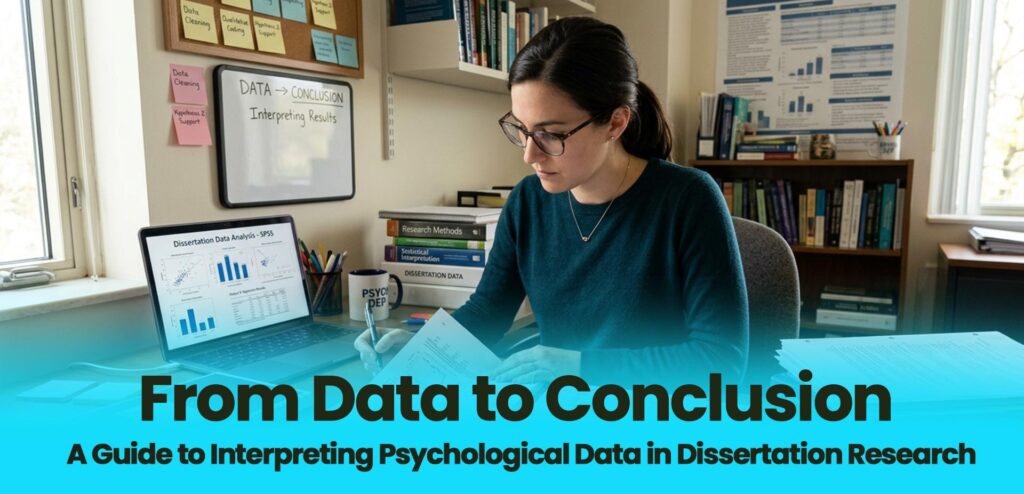
Interpreting data is the heart of any psychology thesis. When the data collection stage finishes, the actual challenge is in analyzing and drawing conclusions from the raw information. Turning data into actionable insights helps with legitimate assertions and also supporting hypotheses in a dissertation. Proper interpretation ensures the research findings are correct but also important within a wider context of psychological practice and theories. In this context, the best psychology dissertation help UK focus on providing comprehensive support for turning data into valuable conclusions, offering clarity and precision in every step of the analysis process.
Various types of Data in Psychology Research.
Collecting data in psychology could involve surveys, experiments, and case studies in addition to observational studies and neuro-imaging. Researchers might gather quantitative data (number, statistical) or qualitative (descriptive, or both, textual), depending on the research question. Test scores, reaction times or brain activity measurements might be quantitative data, and qualitative data may be interview transcripts, thematic observations or case study. The type of data collected influences analysis techniques used and thus interpretation of results.
Analyzing Quantitative and Qualitative Data
For quantitative data, analysis is mainly statistical. Descriptive statistics such a mean, median, and standard deviation summarize the information, while inferential data like t-tests ANOVA, and regression enable researchers to test hypothesized results and make predictions. Interpreting statistical results entails deciding if an outcome is significant statistically, how big the result is, and in case the findings support or even deny the research hypothesis. In qualitative data, analysis generally consists of coding and classifying themes or patterns in the data. Methods such as thematic analysis or grounded theories interpret meanings behind participants’ responses and also identify overarching trends and insights that aren’t readily quantified but crucial to understanding psychological phenomena.
Whenever data are analyzed, the interpretation of the results should take place within the context of the original research questions and hypotheses. In order to draw useful conclusions, one has to think about the practical as well as statistical significance of the results. Relate the findings to the literature examined in the dissertation to describe how they support or challenge earlier research. Conclusions also ought to deal with limitations of the research, such as possible biases, possible confounding variables or methodological limitations.
This particular critical assessment of the data supports the conclusions and also hints at future directions for study. In case you want some assistance with your dissertation or wish to make certain your conclusions are good, you can turn to dissertation writing service UK.
Conclusion
Comprehending psychological data is essential to a good dissertation, to conclude. Clear interpretation and analysis enable researchers to make important contributions to psychology. Converting raw data into insights confirms or negates assumptions, and also improves academic debate of psychological issues. Data interpretation is thus essential for the creation of any psychology dissertation and essential for scientifically rigorous and intellectual research. In case you are searching for affordable assignment help to assist you with your dissertation, keep in mind that expert support can help perfect your research and interpretation.