There is a particular kind of longing that hits a dorm room in late September. The light outside turns gold around five o’clock, the campus paths fill up with people in cardigans they have clearly been waiting all summer to wear, and you look around your cinder-block box with its overhead fluorescent tube and its single plastic chair and think: this is not what autumn is supposed to feel like. The catch, of course, is that the fall aesthetic you have in your head usually comes with a price tag. Chunky knit blankets, matching ceramic mugs, a wall of candles, a bookshelf that looks styled rather than lived in. None of that fits inside a budget that already has to stretch across textbooks, meal-plan gaps, and the occasional emergency coffee.
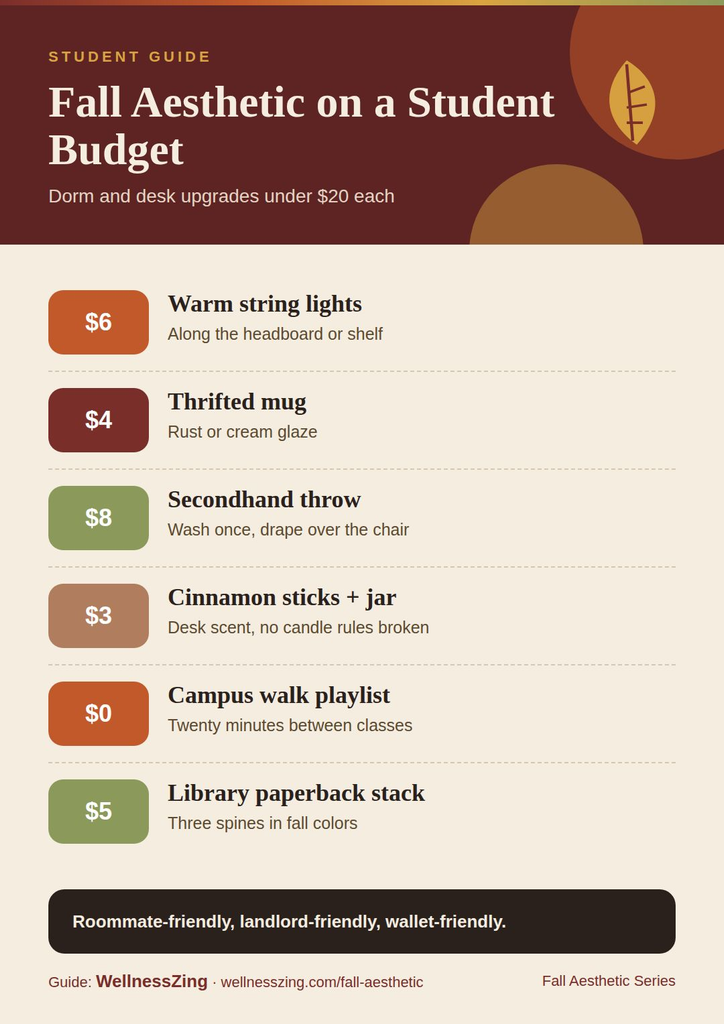
The good news is that most of what makes a room feel like fall has almost nothing to do with spending. It has to do with light, warmth, scent, sound, and something to hold in your hands. Each of those can be handled for a few dollars if you know where to look, and several of them can be handled for nothing at all. The infographic below breaks the whole thing into six small upgrades, each one under twenty dollars, that together turn a bare student room into somewhere you actually want to spend an October evening. We will walk through every item on it, explain why each one earns its spot, and add the practical details that a chart does not have room for.
As the infographic above shows, the six upgrades run from six dollars down to free, and the whole list stays comfortably under twenty. The first item is a strand of warm string lights for about six dollars, which is the single biggest change you can make to a room lit by a ceiling tube. The second is a thrifted mug for around four dollars, because a warm drink in a cup you actually like is half of what people mean when they say a room feels cozy. Third is a secondhand throw for roughly eight dollars, the soft layer that makes a standard-issue dorm bed or a hard desk chair feel like a place to sink into.
The fourth item on the chart is the clever one: a jar of cinnamon sticks for about three dollars, which gives you the scent of fall without breaking the no-open-flame rules that nearly every residence hall enforces. Fifth is a campus walk playlist, listed at zero dollars, because the fall mood is not only something you build indoors. And sixth is a library paperback stack, budgeted at around five dollars for the stragglers you cannot find on the shelves, which handles both the visual and the actual pleasure of having something good to read when the sun goes down at six. Add the numbers up and the chart lands the whole room refresh at well under a twenty-dollar bill, with room to spare.
Warm string lights: fix the light first
If you only do one thing on this list, make it this one. Dorm lighting is designed for cleaning and inspections, not for living. A single overhead fixture throws flat, slightly blue light into every corner at once, which is exactly the opposite of what a fall evening looks like. Autumn light is low, warm, and directional. It comes from the side, it leaves shadows, and it makes everything look a little softer than it is.
A six-dollar strand of warm-white string lights does a surprisingly convincing impression of that. Look for the words “warm white” on the package rather than “cool white” or “daylight.” The warmer the better. Battery-powered strands are the easiest to place because you are not fighting for one of the two outlets in the room, and many come with a small timer so they switch themselves on at dusk and off after a few hours. Run them along the top edge of a bookshelf, drape them behind the headboard, or loop them loosely around the window frame so the light bounces off the glass.
The real trick is to turn the overhead off entirely once the strand is up. A room lit only by a few dozen tiny warm points feels completely different from the same room with the ceiling light on. It reads as evening. It slows you down. It is also, incidentally, much kinder to a roommate who wants to sleep while you are still reading. This is the moment most students realize that the fall aesthetic they were chasing was never really about pumpkins; it was about getting the light right and letting everything else follow.
A thrifted mug: the four-dollar centerpiece
It is hard to overstate how much a mug matters to a room’s mood, especially in a space where you may only have a kettle or a microwave to work with. Cafeteria cups and the free plastic tumbler from orientation do the job, but they do not make you want to sit down. A heavy ceramic mug in a color you actually chose does something else. It becomes the thing you reach for at nine at night, the object that signals the day is winding down.
Thrift stores and campus swap shelves are full of them, often for a dollar or two, and four dollars will get you a genuinely nice one. Look for weight and a comfortable handle before you look at the pattern. Speckled glazes, deep greens, rust oranges, and plain cream all sit well in an autumn room. Avoid anything with a chip on the rim; a chip on the base is fine and usually knocks the price down further.
Once you have it, keep it out. A mug that lives on the desk or the windowsill, rather than in a bin under the bed, becomes part of how the room looks even when it is empty. Pair it with a box of whatever tea or cocoa you can get from the dining hall or a corner store, and you have handled the warm-drink ritual that shows up in every fall guide ever written without spending more than the price of a single café latte.
A secondhand throw: soften every hard surface
Dorm furniture is built to survive, not to be comfortable, and the fastest way to disguise that is a layer of soft fabric. An eight-dollar throw from a thrift store or a campus buy-nothing group covers a scratchy comforter, turns a plastic desk chair into somewhere you can curl up, and gives the whole room a texture it did not have before. It is the item on the list that changes how the room feels to the touch, not just how it looks.
Secondhand is the way to go here, and not only for the price. Older throws have usually been washed enough times to lose any stiffness, and the slightly faded colors that come with age happen to be exactly the muted burgundy, mustard, and chestnut tones that suit fall. Check the label for a mostly cotton, wool, or acrylic blend, give it a good sniff, and run it through a hot wash the day you bring it home. Fringe and cable knits look wonderful but snag on everything in a small room; a simple woven or fleece throw is more practical for a space you actually study in.
Where you put it matters as much as what it is. Draped loosely across the foot of the bed, it makes the bed look made even when it is not. Folded over the back of the chair, it invites you to sit. Bunched on the floor beside the window with a pillow, it creates a reading spot where there was previously just carpet. One throw, three uses, eight dollars.
Cinnamon sticks in a jar: scent without the fire alarm
Every fall list wants you to light a candle. Almost every residence hall forbids it, and for good reason. The infographic sidesteps the problem entirely with three dollars of cinnamon sticks in a jar, which is one of the oldest and cheapest tricks for making a room smell like the season without an open flame, a hot plate, or a wax warmer that might also be on the banned list.
Buy whole cinnamon sticks from the bulk or international aisle of a grocery store, where they cost a fraction of the price of the little jars in the spice section. Drop a handful into any clean glass jar, a rinsed pasta-sauce jar works perfectly, and leave the lid off. The scent is subtle at first and builds over a day or two. To wake it up, snap a stick in half or rub two together for a few seconds. If you have a few whole cloves or a dried orange peel from lunch, add those in and the jar starts to smell like something simmering on a stove.
The jar also earns its place visually. A cluster of cinnamon sticks standing upright in glass looks intentional in a way that very few three-dollar objects do. Set it on the desk near the string lights so the warm glow catches the glass, and you have covered scent and decor in one move while keeping your resident advisor entirely happy.
A campus walk playlist: the free upgrade
Not everything on the chart lives inside the room, and this is the item that costs nothing at all. A fall playlist built specifically for walking across campus is one of the most reliable ways to actually notice the season instead of hurrying through it with your head down. The leaves, the smell of cold air, the way the buildings look different at four in the afternoon in October than they did in August: all of it is easier to take in when you have given yourself a soundtrack and a reason to walk the long way.
Build it deliberately. Aim for about forty-five minutes, roughly the length of a slow loop around most campuses or a walk to the far coffee cart and back. Start with something quiet enough to match the first few minutes of stepping outside, let the middle section pick up a little, and end with the two or three songs you want to hear as you come back to your door. Acoustic tracks, soft indie, older folk, and anything with a piano tend to suit the mood. Skip anything you would normally listen to at the gym.
Then use it. Take the walk after your last class of the day rather than heading straight back to the room, or carve out twenty minutes on a Sunday afternoon when the light is at its best. The playlist costs nothing, but the habit of going outside on purpose during the shortest and prettiest weeks of the semester might be the most valuable thing on the whole chart.
A library paperback stack: five dollars for a shelf that looks lived in
The last item is the one that makes the room look like someone interesting lives there. A short stack of paperbacks on the desk or windowsill is a fall decor staple for a reason, and the campus library will lend you most of it for free. The five dollars on the chart is for the used-bookstore stragglers: the battered novel with the good cover, the poetry collection nobody has checked out since the nineties, the mystery you want to keep past the due date.
Choose books you will actually open. A stack that is purely decorative feels a little hollow, but a stack you are working through, with a bookmark sticking out of the top one, is exactly the kind of small detail that makes a space feel warm. Fall reading tends to run toward campus novels, ghost stories, slow literary fiction, and anything set in a cold place. Stack them spine-out, largest on the bottom, and let the mug or the cinnamon jar sit on top as a bookend.
Pair the stack with the string lights and the throw and you have, without quite meaning to, built the reading nook that every fall mood board promises. The difference is that yours cost less than a pizza. The team at WellnessZing put together a much broader guide to getting into the fall mood without buying a single pumpkin, and its central idea is the same one running through this list: the season is a feeling you set up, not a shopping cart you fill.
Putting the six together
None of these upgrades is impressive on its own. A strand of lights, a mug, a blanket, a jar of spice, a playlist, a few books. What makes them work is the order and the combination. Do the lights first, because they change how everything else looks. Add the throw and the mug next, because they change how the room feels to sit in. Set out the cinnamon jar and the book stack once the first three are in place, so they have somewhere warm to sit. Build the playlist whenever you have a spare half hour, and then take it for a walk.
Spread the purchases across two or three weeks if even twenty dollars is a stretch right now. The room does not need to be finished by the first of October. It only needs to start feeling like yours, and like the season, one small thing at a time. That is the whole point of a student version of the fall aesthetic: it should fit your life, not the other way around.
Conclusion
A dorm room in autumn does not have to feel like a waiting room with a window. Six small choices, all of them under twenty dollars combined, cover light, warmth, scent, sound, and something to read, which is everything the season actually asks for. The infographic gives you the shopping list; the rest is a couple of thrift-store trips and a willingness to turn the overhead light off. Start with the string lights tonight, and see how different the room feels by the end of the week.