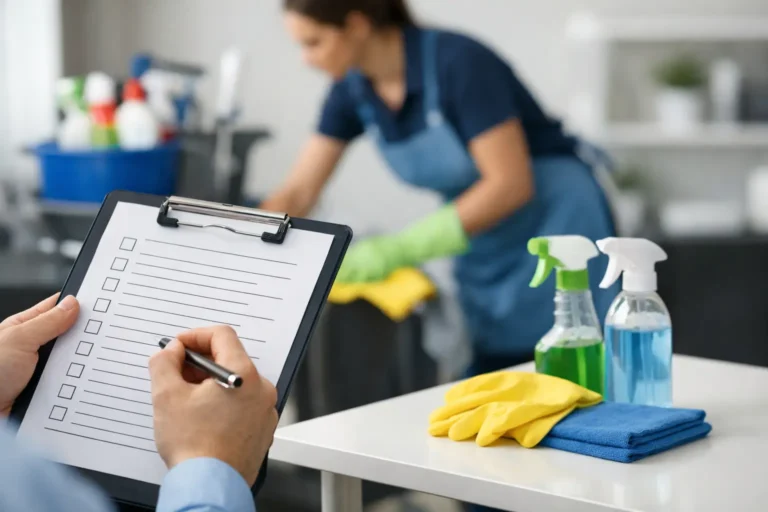
Ask commercial cleaning clients why they switched providers and the answer is rarely price alone. More often it is a slow buildup of small disappointments: a restroom bin left full, dust on the same reception desk week after week, a conference room missed after a late meeting. Each lapse feels minor, but together they tell the client that nobody is really watching.
Quality control is how a cleaning company proves that someone is. A good inspection routine catches problems before the client does, gives crews clear feedback, and creates a record you can show at renewal time. Here is how to build one that works in the real world, not just on paper.
Define What “Clean” Means for Each Site
Inspections only work when everyone agrees on the standard. “Clean the restrooms” means different things to different people. One cleaner wipes the sinks and mops; another also descales the faucets, polishes the mirrors and checks the partition tops.
Start by turning each site’s scope of work into a checklist of observable results. Instead of “clean kitchen,” write “counters free of crumbs and streaks,” “sink drained and wiped,” “microwave interior clean,” “floor free of spills and debris.” Each item should be something an inspector can look at and mark as pass or fail without debate.
Keep checklists site-specific. A dental office, a warehouse break room and a law firm lobby have different priorities, and a generic list will either miss what matters or waste time on what does not.
Use a Simple Scoring System
Complex scoring systems tend to be abandoned within a month. A straightforward approach works better: score each area on a three-level scale such as meets standard, needs attention, or failed. Calculate an overall percentage for the visit and track it over time.
The trend matters more than any single score. A site that drifts from 95 percent to 85 percent over two months is signaling a problem, perhaps a new crew member who needs training, a change in building use, or a scope that has outgrown its scheduled hours.
Set an Inspection Frequency You Can Sustain
Supervisors are busy, and an inspection plan that requires them to visit every site every week will collapse quickly. A more realistic approach is tiered frequency. High-value or high-risk accounts, such as healthcare facilities or clients with a history of complaints, get inspected weekly. Stable, low-risk accounts might be inspected monthly. New accounts get extra attention during their first sixty days, when expectations are still being set.
Inspections do not always have to be done by a supervisor, either. Experienced crew leaders can carry out peer inspections on sites they do not usually clean, which spreads the workload and gives them a fresh perspective on standards across the company.
Random timing also helps. If crews know the supervisor always comes on the first Monday of the month, standards may peak on that day and dip on the others.
Capture Evidence, Not Just Checkmarks
A checklist marked “pass” proves little if a client later disputes it. Photos turn an inspection into evidence. Ask inspectors to photograph a few key areas on every visit, along with any item marked as needing attention or failed.
Crews can contribute too. Before-and-after photos of restrooms, kitchens or floors at the end of each shift give supervisors a quick way to spot-check sites they cannot visit in person. When this is built into a cleaning business management software workflow, photos are attached to the specific job and timestamped automatically, so nobody has to dig through phone galleries or chat threads to find them later.
Close the Loop With the Crew
An inspection that ends with a score in a spreadsheet changes nothing. The value comes from what happens next.
Share results with the crew promptly, ideally within a day. Lead with what was done well, then point to specific items that need improvement, using photos where possible. Keep the tone practical rather than punitive. Most quality issues come from unclear expectations, rushed schedules or missing supplies, not from people who do not care.
When the same item fails repeatedly, dig into the cause. Does the crew have enough time scheduled? Are the right products on site? Has the client changed how the space is used? Fixing the root cause is far more effective than repeating the same correction every week.
Bring the Client Into the Process
Many cleaning companies treat inspections as a purely internal exercise. That is a missed opportunity. Clients rarely see the work, because it happens after hours, so they judge you by the few things they notice in the morning. Sharing a short monthly quality summary changes that perception.
A one-page report with average scores, a handful of photos and any corrective actions shows the client that their facility is being actively managed. It also gives them a clear channel to raise concerns before they turn into frustration. Some companies schedule a joint walkthrough with the client contact every quarter, which builds trust and often uncovers opportunities for additional services.
Respond to Complaints Fast and Visibly
Even with strong inspections, complaints will happen. How you respond often matters more than the original mistake. Acknowledge the complaint the same day, send someone to fix the issue as quickly as possible, and follow up with a photo showing the result.
Log every complaint against the site and the area involved. Over time, this log reveals patterns that inspections alone may miss, such as problems that only appear on certain days or after certain events in the building.
Make Quality Part of Your Culture
The best inspection routines eventually become less about catching mistakes and more about reinforcing pride in the work. Recognize crews whose sites consistently score well. Share positive client feedback with the people who earned it. Use inspection data when deciding on raises or promotions to crew leader roles.
When cleaners see that quality is noticed and rewarded, standards rise on their own. Clients notice too, and that is what keeps contracts renewing year after year.