When the World Cup arrives, the calendar stops feeling normal. Kick-off times cut across workdays, family routines, and sleep, yet the more you care about tactics and performance trends, the more you feel that highlights are not enough. The real challenge is designing a month where you can still watch full matches closely without burning out your energy, your job, or your relationships.
Why Balance Matters If You Care About Match Understanding
To read pressing schemes, rest-defense structures, and chance quality properly, you need a reasonably fresh mind. Chronic sleep loss and constant multitasking turn full matches into background noise where everything blurs into “good” or “bad” without nuance. That is how fans end up relying on hot takes instead of what actually happened between the boxes.
Thinking about balance as part of your World Cup plan is not about being less passionate. It is about protecting the quality of your attention. When you choose which games to watch deeply and which to follow lightly, you give yourself a better chance of noticing shape changes, momentum swings, and in‑game adjustments that never show up in short highlight clips.
Choosing a Primary Lens: Work, Family, or Football Priority?
Before the tournament starts, it helps to be honest about which area of life cannot be compromised. For some, work deadlines or exams are immovable; for others, family commitments or young children set the outer limits. Football then has to fit around that non‑negotiable axis, not the other way around.
From a viewing perspective, this choice clarifies which fixtures are worth full focus and which must be treated as optional. If work is the anchor, you might only watch late games in full and rely on extended highlights for early kick‑offs. If family time is the anchor, you might build “shared viewing” into a few evening matches and accept that other games will be watched on delay, with the phone turned off to avoid spoilers but without sacrificing key routines.
Turning Live Viewing Into a Structured Slot ดูบอลสด
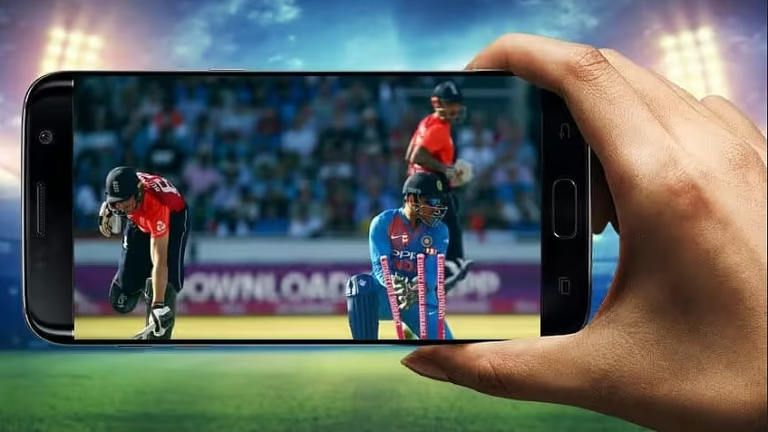
The temptation during the World Cup is to let matches seep into every free moment: a game on the laptop while eating, another in the background while answering emails, and a final one just before sleep. A better approach is to turn ดูบอลสด into a clearly defined slot—more like a scheduled meeting than ambient entertainment. When you treat one match per day as your “main live game,” you can prepare for it: quickly review both teams’ previous patterns, note any interesting tactical questions (pressing height, build-up variations, how they protect central zones), and watch from kick-off to final whistle with minimal distraction. That single focused game often teaches you more about systems and trends than three half-watched fixtures where you miss the sequences between goals. Outside that slot, you can follow other matches via recaps and data without feeling you have to be glued to the screen all day.
A Practical Decision Sequence for Each Matchday
On any given matchday, it helps to walk through the same short decision sequence rather than improvising. This keeps your choices aligned with work, family, and health instead of chasing every possible game.
One effective daily sequence could be:
- Check the schedule in the morning and identify the one or two highest-priority matches for your interests—teams you have been tracking, tactically intriguing clashes, or key group deciders.
- Compare those kick-off times with your work and family obligations, then decide which single match you can realistically watch in full without multitasking, and which others you will follow via highlights or post-match analysis.
- Block that chosen match in your calendar like an appointment, and adjust around it—finish key work tasks before it, or agree with family when you will be fully present outside that 2-hour window.
- After the game, limit yourself to a brief review period (10–20 minutes) to check shot maps, average positions, or a trusted tactical breakdown, then disconnect so sleep and non-football life do not get swallowed by endless reactions.
Repeating this process across the month gradually builds a rhythm where football, work, and family coexist, rather than constantly colliding.
Comparing Different Balance “Profiles” for Viewers
People enter a World Cup with different constraints. Thinking in terms of profiles makes it easier to choose habits that fit your reality instead of copying someone else’s routine.
| Viewer Profile | Non‑Negotiable Priority | World Cup Viewing Strategy |
| Office‑heavy schedule | Fixed work hours, early mornings | One focused evening match; others via recaps |
| Shift worker | Irregular hours, variable sleep | Rotate match slots; choose rest days strictly |
| Parent with young kids | Family routines, bedtime anchors | Co‑watch early games; late matches only on select nights |
| Freelancer / remote | Flexible hours but deadline peaks | Treat matches as fixed anchors, work in defined blocks |
| Health‑first viewer | Sleep, training, and mental energy | Prioritise fewer matches, focus on tactical interest only |
Once you identify your closest profile, you can fine-tune the details—number of late nights, which match windows to target, and how often you accept watching on delay to protect sleep or family time.
Protecting Sleep and Physical Health While Watching Intensely
Sleep and basic physical habits are often the first casualties of a major tournament, but they also drive your ability to process matches properly. Poor sleep reduces your capacity to track off-ball movement, recognise pressing triggers, and remember the context around key chances.
To keep health from quietly eroding, it helps to set firm limits before the first game: maximum number of late matches per week, a cut-off time for screens after night games, and at least one “light” day every 4–5 days with no live viewing. Adding short walks, stretching, or even simple exercises during half-time can offset long periods of sitting, and drinking water instead of only caffeine or alcohol reduces the post-match crash that makes early meetings or school runs painful.
Keeping Relationships Onside While the Tournament Runs
A World Cup can become a source of friction if people around you feel replaced by the schedule. Being proactive makes a big difference. Sharing the fixture list in advance and marking out which games you truly care about invites negotiation: others can see that you are not treating every group match like a final, and you can invite them into specific fixtures as shared events.
Where possible, fold family or partner time into match viewing by choosing games that lend themselves to explanation—those where you can point out tactical shapes, key players, and storylines without needing total silence. For matches you know you will want to watch in full concentration, it is better to be clear: agree on that protected window and compensate with time and attention before or after, so those two hours feel like part of a balanced day, not an unexplained disappearance.
Summary
Balancing the World Cup with work, family, and health is less about self-denial and more about deliberate prioritisation. By choosing a main live match each day, fitting it around your non‑negotiable responsibilities, and protecting sleep and relationships, you give yourself the conditions to watch with a clear, analytical eye. The reward is that when you sit down to follow a game—its pressing patterns, build‑up shapes, and moment‑to‑moment momentum—you are fully present, and the tournament becomes a month of genuinely understood ช่องทางดูบอลสด โกลแดดดี้ rather than a blur of tired late nights.